There’s something funny happening with “building in public”: The post that made this person 2,000 followers on X wasn’t a product demo or a building-in-public thread but a gym selfie where people thought her cap logo looked like a butthole.
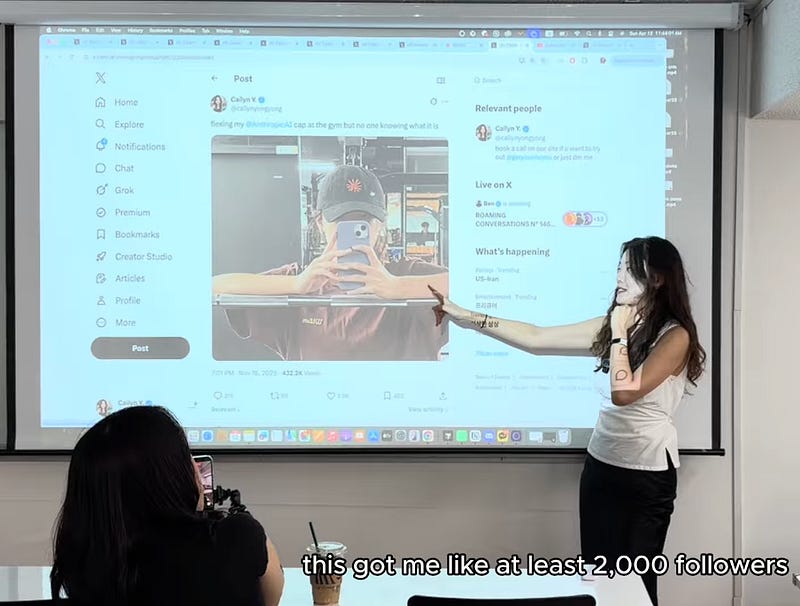
I’ve been following a founder named Cailyn for a while, not because I use her product but because she’s one of the few people whose “building in public” content doesn’t feel like a performance. She runs a startup called Momo and has built a real following on X and Youtube by doing what the playbook says: tagging communities, posting daily, studying which tweet formats go viral in her space and adapting her own content around those templates.
When she was reviewing her first 9 months of “build in public” journey, the thing that actually blew her up was a gym selfie. She was wearing a cap with the Anthropic logo on it and people in the comments started saying the logo looked like a butthole. Funny enough the algorithm kept pushing the post because the word butthole drives engagement, and she picked up something like 2,000 new followers overnight. Not from a single piece of strategy content.
I thought that was interesting and kind of revealing.
You hear “building in public” everywhere now. Every founder, every creator, everyone trying to grow an audience or launch something. The advice for them is always the same: share your journey, be transparent, be vulnerable. And I think there’s genuine value in that because when it works, it gives people a reason to care about what you’re making before the product itself is any good.
But I’ve been noticing it start to shift. For a growing number of people, “building in public” has become more of a label than an actual practice. They enjoy telling people they’re part of the “building in public” category more than they enjoy the actual process of sharing. I’ve even seen some founders get weirdly gatekeepy about it, saying things like “go Google what building in public means” as if it’s a members-only club.
And at some point the documentation starts to become the product. You’re posting updates and sharing “lessons” and crafting narratives around your journey, and the building itself quietly slides into the background. Which is kind of the opposite of the whole idea.
What makes Cailyn’s content work, I think, is that she doesn’t seem to be optimizing for the “building in public” audience. She’s just sharing what’s actually happening, and what’s actually happening includes pivots and things not working out and stretches where nothing interesting is going on. It doesn’t feel curated. And the irony is that the moment that got her the most traction, the gym selfie, was probably the least strategic thing she ever posted.
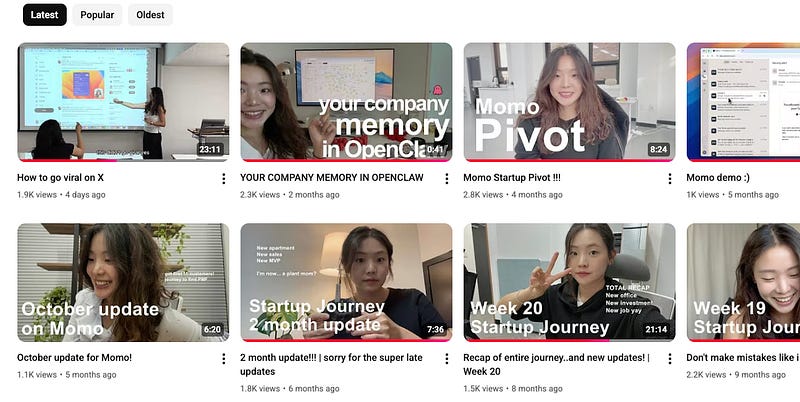
There’s a filter I keep coming back to when I think about this, which is: would you still be posting even if nobody was watching? Not as a discipline thing or a “consistency is key” thing. More like, are you the kind of person who documents because that’s how your brain works, or are you doing it because someone told you it’s a growth hack?
Because I think the people who’d be doing it either way are the ones who eventually stumble into something that catches. And the people who are performing “building in public” as a strategy tend to produce content that’s strangely smooth and polished and clean, which is actually a tell, because a real process has weird weeks and dead ends and moments where you genuinely don’t know if the thing you shipped is going to work.
I don’t have a clean conclusion for this since the whole thing about being “data-driven” and performance marketing exist for a reason. I’m still figuring out where I fall on that spectrum myself. But there’s something worth sitting with in the fact that for someone who had the whole playbook down, the moment that broke through was the one she couldn’t have planned for.