Say you’re on a growth team at a B2B company that sells multiple products: some standalone, some bundled into a platform. Leadership asks you: given the limited resources, which product should we focus?
This was a real interview question I had this week with a series A B2B SaaS company.

The way I think about this now is to step back from the product lineup entirely and look at the actual question with first principle. The real problem is on growth problem rather than product comparison:
what adds pipelines and gets new clients into our ecosystem?
Once it’s framed that way you’re working with completely different criteria:
1
You want to prioritize the product that maps to the biggest pain point most buyers already know, and are actively trying to solve. In other words, the ones where awareness already exists. Because this is the area you can build content and campaigns around language buyers are already using instead of spending months trying to create awareness from scratch.
2
Then there’s the speed question, i.e. sales cycle. How quickly can a buyer say yes and be closed? If the company’s strongest product requires six to eight months of internal evaluation before a client commits, it doesn’t matter how good it is for a near-term growth push. You want the product with the shortest path from “I have this problem” to “let me try this,” where the value is clear enough that a buyer can move without three rounds of approvals. That becomes the entry point to expand from.
This kind of reasoning is pretty intuitive once you see it. You start from what has to be true for the growth goal to work and reason forward rather than ranking products from the top down.
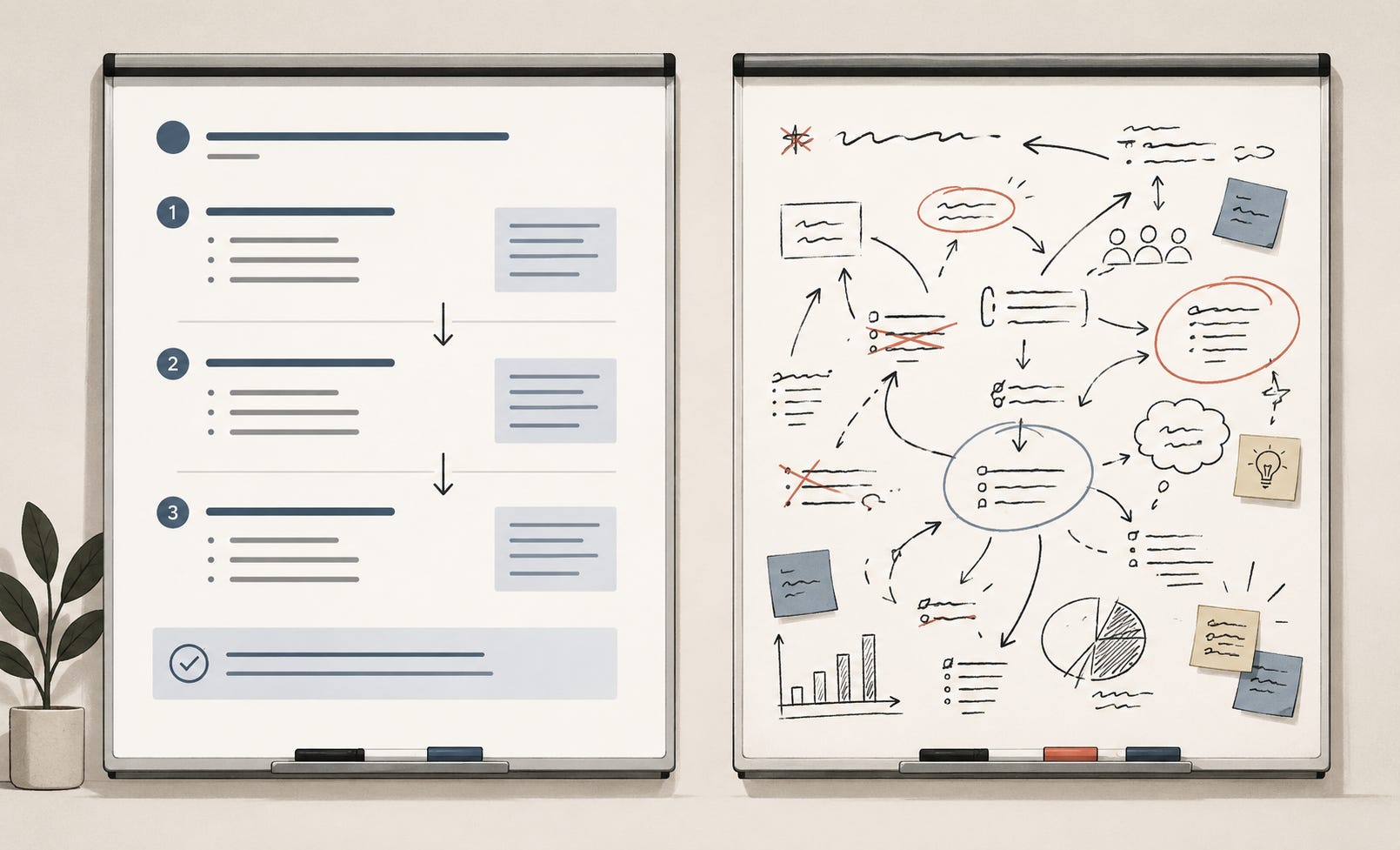
However, all these came from a reflection section since they aren’t the answer I defaulted to when I was in the interview. The hiring manager walked me through their product suite and asked me how I’d decide where to focus. My answer was:
“I’d look at what’s contributing the most revenue, figure out what’s contributing to the most revenue. Say, if 80% of customers are buying two of the five products, start with those two.”
On paper it sounds ok-ish: Data-driven and reasonable, doesn’t make any wild assumptions. But It’s also the most generic, auto-piloted thing I could have said — the moment I said it I knew it was bad lol…
It doesn’t stand for any real world challenge, no real decision logic or point of view on what “focusing” even means in practice. Basically not practical for any real operators.
What I kept coming back to afterwards was why that came out so natural in the moment.
I’ve thought about prioritization problems before, and when I’m not under pressure my reasoning looks nothing like that. But in the actual interview, my brain skipped all of it and went straight to: what would someone with the title of “growth content lead” say here?
And I think that’s the thing actually worth examining because it’s probably a mode I barely realize I was in. When you’re operating from “what would someone in this role say,” you start assembling pieces that sound right for the position. You reach for the language and frameworks that feel credible: Revenue analysis, data-driven prioritization, which a lot of times are “performative” thinking that belongs in a case study rather than working through the actual problem
The shift is honestly simple: instead of “what would someone in this role do,” ask “what absolutely has to happen if we’re hitting this goal?” That question cuts past the title and the performance layer and goes straight to the constraint.
This is what first-principles thinking actually looks like when it’s not a line on a job description. It just means identifying the thing that has to be true and reasoning from there, which usually leads you somewhere less polished but way more concrete than the consulting-style answer.
That space between “I’m actually thinking through this” and “I’m performing what thinking looks like” is way smaller than I expected. And I’m fairly sure it doesn’t only show up in interviews.