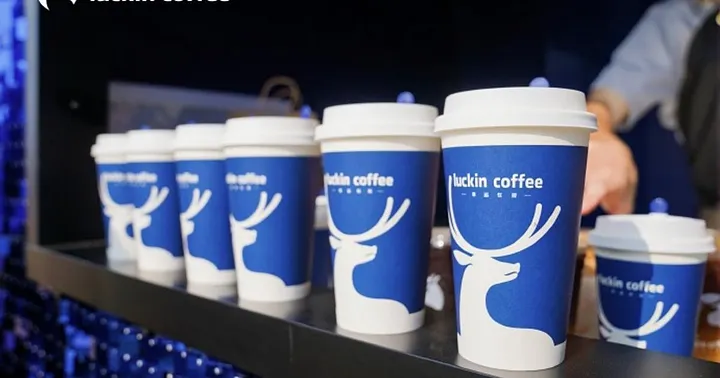
So you might’ve seen this in some business news. Luckin Coffee, the mega-brand from China, has officially landed in the US, opening up shop in NYC. And with it, came the drama.
Someone had a complaint on Reddit about a core Luckin practice: you have to order through their app. No cash, no credit card at the counter, no old-school human interaction. To get that sweet $1.99 coffee, you first have to sacrifice some precious real estate on your phone’s home screen.
Aside from that there was a far more interesting accusation: the claim that Luckin calls itself a “tech company.”

At first glance, it kinda has the markings of a blatant, slightly cringey marketing gimmick: They sell coffee. Starbucks sells coffee. What’s the big deal?
Well, that’s what we’re diving into today — While it seems like a stretch, it’s actually the key to understanding their entire game plan. Luckin isn’t just playing a different game than Starbucks; they’re playing a completely different sport and their model isn’t just about selling coffee
First Things First: Why App-Only?
For most of us, being forced to download an app feels arrogant and is an instant user experience fail. But for Luckin, this is actually the most critical feature and the cornerstone of their entire business model.
Think about a traditional coffee shop, even Starbucks. When a customer pays with cash, what does the company learn about them? Pretty much nothing. They get blurry, high-level data, like “lattes were popular today.”
Now, look at what Luckin gets with every single mandatory app order:
- Your Habits: They know you’re a “large iced oat latte at 8:30 AM” person, not a “small black coffee at 4 PM” person. They know which location is near your office and which is near your home.
- Your Vices: They know your exact preference for sweetness and ice. They know you secretly love those seasonal pumpkin spice knockoffs, even if you’d never admit it to your friends.
- Your Price Point: They know if you’re a loyalist who buys regardless, or a bargain hunter who only shows up for a 50% off coupon.
- Your Social Circle: They know if you’ve ever used a “refer-a-friend” link, giving them a map of your potential to bring them more customers.
This is the most crucial differentiator: optional data vs. mandatory data.
Starbucks’ app is a great loyalty program, but it’s optional. They have a rich dataset on their app users, but a massive blind spot for everyone else. Their picture of the customer base is an incomplete, blurry Polaroid.
Luckin’s app, on the other hand, is the operating system for the entire business. There are no “non-digital” customers. This gives them a 4K, 360-degree live stream of their entire active user base.
This isn’t just being data-informed. This is being truly data-driven. And that, right there, is the DNA of a tech company. Luckin is a data and efficiency company that just so happens to use coffee as the product to fuel its model.

Cool, Luckin Has Better Data. Now What?
This is where the data gets turned into an almost unfair advantage.
1. The Advanced Coupon Game — Precision marketing
No more one-size-fits-all promotions. Luckin runs a sophisticated algorithm game that feels personal to every user.
Think of it this way:
- You are a price-sensitive customer who hasn’t ordered in a while? Here’s a massive 50% off coupon to “reactivate” you.
- You are a die-hard loyalist who buys a coffee every morning? Here’s a standard, less dramatic discount to simply maintain your habit without giving away the farm.
They know exactly which psychological button to push for each specific user to drive a purchase at the lowest possible cost. Their system even auto-detects when you’re about to churn and sends a “we miss you!” coupon to pull you back in.
2. The Unseen Cost Advantage & Speed
Because Luckin was born digital, it carries none of the baggage of traditional retail. Their stores are mostly “grab-and-go” spots, not cozy “third places” with comfy couches and high rent.
They’ve stripped away the fluff to focus on one thing: fulfilling your app order with ruthless efficiency.
This data-driven efficiency creates a powerful cost advantage. The money they save on rent and unnecessary frills gets funneled into two places: lower prices for you, and profit for them.
This digital-native model also makes them incredibly agile. They can A/B test a new drink in one city, push a new marketing campaign to millions with a single click, and tweak operations on the fly based on real-time data.

How Luckin’s Business Model is Fundamentally Different?
Here’s the best analogy to think about it:
Starbucks is like a traditional auto giant like Ford. They build fantastic cars, and they’re investing heavily in new tech like EVs. But at their core, their DNA, sales network, and business model are still deeply rooted in the legacy world of dealerships and combustion engines.
Whereas Luckin is like Tesla. From day one, it wasn’t building a “car with a battery”; it was building a “computer on wheels.” The real product is the software, the data, the OTA updates, and the charging network. The car is just the sleek hardware that delivers that experience.
Yes, every company uses data. Starbucks is using data to optimize its coffee empire. Luckin is using coffee to build its data empire.
And that leaves us with the big, unanswered question:
The model is ruthlessly efficient. But is it what Americans want? Can a cold, data-driven system win over a consumer culture that often values human interaction, brand experience, and the simple act of chatting with a barista?
Let me know what you think in the comments:)
reference:
https://www.reddit.com/r/nyc/comments/1lp4vwx/luckin_coffee_violating_cash_payment_law/
https://www.timeout.com/newyork/news/the-starbucks-of-china-has-officially-opened-in-nyc-060424
https://www.sec.gov/Archives/edgar/data/1767582/000119312519149433/d713349df1.htm